


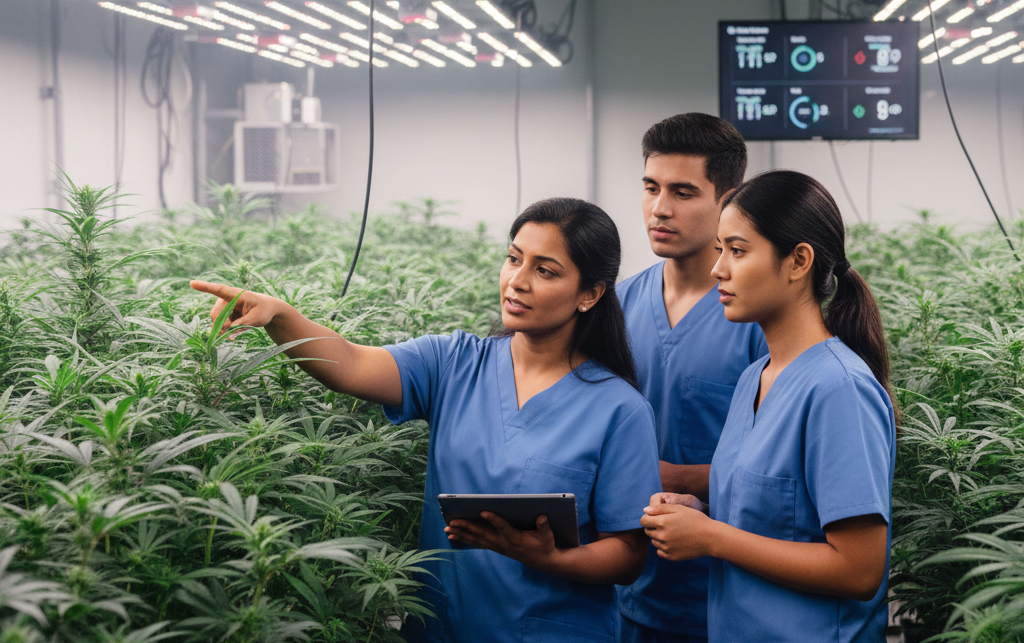
The image of a cannabis grower might conjure up scenes of a passionate individual tending to a few plants in a backyard. While that romantic ideal has its place, the reality of commercial cannabis cultivation is far more complex, demanding, and utterly fascinating. In the legal cannabis industry, growing isn’t just a hobby; it’s a highly skilled profession that requires a deep understanding of horticulture, business operations, and meticulous compliance.
At Cannavision College, our Cannabis Cultivation and Horticulture Diploma program is designed to transform enthusiasts into expert professionals, ready to lead in the dynamic world of commercial cannabis.
We frequently get asked: “What does a Cannabis Cultivation Manager actually do every day?” The answer is, a little bit of everything! It’s a role that combines the precision of a scientist, the foresight of a project manager, and the green thumb of a seasoned farmer.
Let’s pull back the curtain and explore a typical day in the life of a Cannabis Cultivation Manager.
The Sunrise Shift: Data Review and Environmental Control (6:00 AM – 8:00 AM)
A Cultivation Manager’s day often begins before most of the team arrives, especially in facilities with staggered shifts or continuous operations. The first critical task is to review the environmental data from the previous night.
- Environmental Monitoring: Checking climate control systems for temperature, humidity, CO2 levels, and vapor pressure deficit (VPD) readings. Are there any anomalies? Did the HVAC system perform optimally?
- Watering Schedules & Nutrient Delivery: Verifying that irrigation cycles completed as planned and that nutrient solutions were delivered correctly.
- Integrated Pest Management (IPM) Checks: A quick scan of sticky traps and plant undersides for early signs of pests or diseases is crucial. Early detection saves crops and prevents widespread issues.
- Light Schedules: Confirming that lighting cycles are precisely on schedule, especially in flowering rooms where light deprivation is critical.
This early data review allows the manager to anticipate issues and plan the day’s tasks, ensuring the cultivation environment is consistently optimized for plant health and yield.
Morning Rounds: Plant Health and Team Management (8:00 AM – 12:00 PM)
Once the team arrives, the manager transitions into a hands-on and leadership role:
- Plant Walk-Throughs: This is the heart of the job. The manager meticulously inspects plants in each growth stage (clone, vegetative, flowering). They’re looking for signs of nutrient deficiencies, over-watering, under-watering, stress, or any subtle changes in plant morphology that could indicate a problem. They might manually check soil moisture or inspect roots.
- Team Huddle: Meeting with cultivation technicians to assign daily tasks such as defoliation, pruning, transplanting, harvesting, or cleaning. Providing guidance and answering questions is key to maintaining efficiency and quality.
- Cloning & Propagation: Overseeing the propagation areas, ensuring new clones are healthy, properly labeled, and receiving optimal care for root development.
- Nutrient Mixing: Supervising or personally preparing nutrient solutions, ensuring precise pH and EC (electrical conductivity) levels for different growth stages and strains.
This period is dynamic, requiring sharp observational skills, problem-solving, and effective communication.
Afternoon Focus: Compliance, Planning, and Problem Solving (12:00 PM – 4:00 PM)
The afternoon often shifts to more administrative and strategic tasks, although unexpected plant issues can always pop up:
- Compliance Documentation: Updating seed-to-sale tracking systems (like Metrc) with plant counts, movements, waste disposal, and harvest weights. Meticulous record-keeping is not just good practice; it’s a legal requirement.
- Inventory Management: Ordering new supplies—nutrients, growing media, IPM tools, and equipment—and managing stock levels to prevent shortages.
- Harvest & Post-Harvest Coordination: Planning upcoming harvests, coordinating with the drying/curing team, and ensuring proper procedures for trimming and packaging.
- R&D and Strain Selection: Researching new strains, evaluating genetic performance, and planning future cultivation cycles based on market demand and facility capabilities.
- Troubleshooting: Addressing any issues identified during morning rounds—adjusting climate controls, treating specific plants, or calibrating sensors. This often involves critical thinking and quick decision-making.
End of Day: Strategy and Preparation (4:00 PM – 5:00 PM)
The final hour is dedicated to wrapping up the day and preparing for the next.
- Final Rounds: A last check of critical systems and plant health before the facility enters its “night cycle.”
- Reporting: Summarizing the day’s activities, reporting any significant observations to senior management, and reviewing key performance indicators (KPIs) like yield projections or growth rates.
- Scheduling: Adjusting the next day’s schedule based on progress and any new priorities.
Start Your Career in Cannabis Cultivation and Horticulture!
Being a Cannabis Cultivation Manager is a demanding, yet incredibly rewarding career that places you at the very heart of the cannabis industry. It’s a role that constantly challenges you to learn, adapt, and innovate, blending scientific principles with hands-on agricultural practices and astute business management. If you possess a passion for plants, an eye for detail, and a desire to contribute to a rapidly evolving industry, then this path could be perfect for you.
At Cannavision College, our Cannabis Cultivation and Horticulture Diploma program provides you with the foundational knowledge and practical skills needed to step into this exciting role with confidence. We equip you with the expertise in plant science, environmental control, pest management, and compliance that today’s commercial grows demand, setting you up for success from day one.
FAQs
Q1. Is cannabis cultivation a physically demanding job?
A: Yes, it can be. While a manager spends time on planning and oversight, they are also on their feet constantly, bending, lifting, and moving around the grow rooms. It requires good physical stamina and the ability to work in warm, humid environments.
Q2. Do I need a science degree to become a Cultivation Manager?
A: While a horticulture or botany degree can be helpful, it’s not strictly necessary. Practical, hands-on experience combined with specialized vocational training, like our Cannabis Cultivation and Horticulture Diploma at Cannavision College, is often more valuable to employers. We focus on the applied science and operational skills truly needed in commercial grows.
Q3. What’s the typical career path for a Cultivation Manager?
A: Many start as Cultivation Technicians or Assistants, gaining experience with plant care. From there, they might move to Lead Cultivator, then Cultivation Manager, and eventually to Director of Cultivation or even VP of Operations, overseeing multiple grow facilities. The industry is growing rapidly, creating ample room for advancement for those with dedication and expertise.