

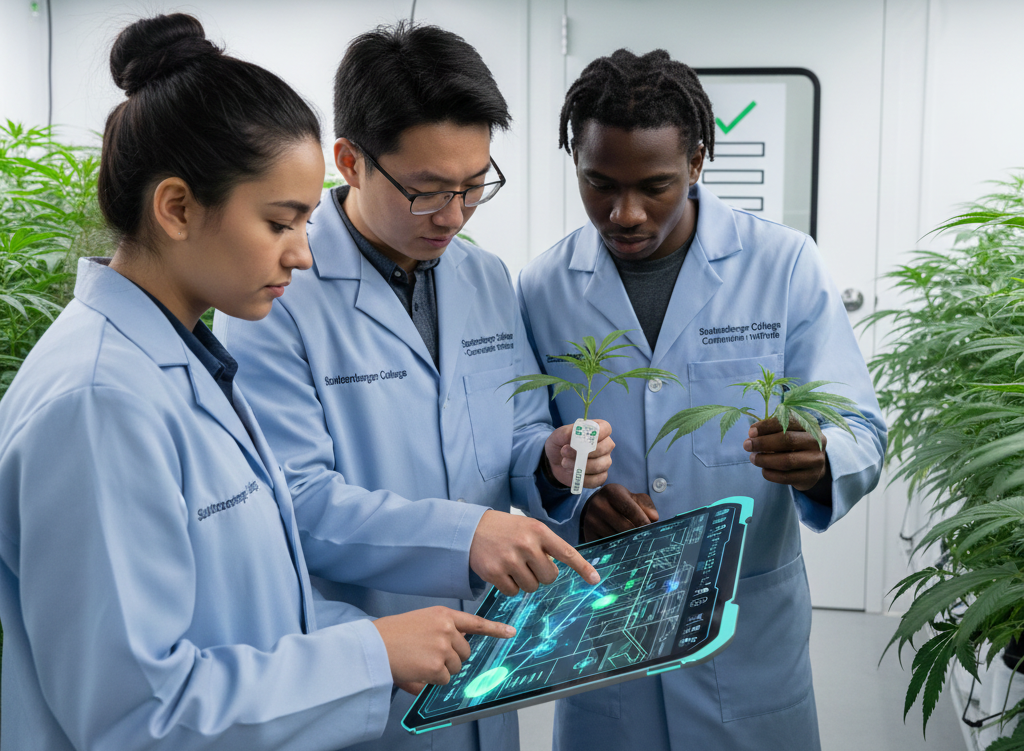
The legal cannabis industry is no longer a “wild west” of unregulated growth; it has matured into one of the most strictly overseen sectors in the United States.
In 2025, staying compliant isn’t just a best practice—it’s a legal mandate for survival. As states like Ohio refine their adult-use frameworks, the demand for professionals who understand the intricate web of “seed-to-sale” tracking, packaging laws, and laboratory standards has reached an all-time high.
At Cannavision, we recognize that the future of this industry depends on expert oversight. Our Cannabis Compliance and Administration program (offered through our Cannavision Institute division) is a 7-month, 100% online diploma designed to turn enthusiasts into regulatory experts.
Whether you are looking to manage a dispensary or work for a state governing agency, we provide the foundational knowledge needed to navigate this complex legal landscape.
If you’re wondering how to secure a cannabis compliance certification and launch your career in 2025, here is your comprehensive roadmap.
1. Understand the 2026 Regulatory Landscape

The first step toward certification is understanding what you are actually complying with. In 2025, state regulations—particularly in Ohio—have become more granular.
- Third-Party Audits: Starting in 2025, Ohio has introduced mandatory third-party certifications for license renewals. This means businesses must prove their financial and operational integrity to independent auditors.
- Metrc Integration: Most states now utilize Metrc (Marijuana Enforcement Tracking Reporting Compliance) as their primary “seed-to-sale” software. Certification often requires proving you can manage this system without error.
- Employee Training Mandates: New rules taking effect in early 2026 (with preparation required throughout 2025) demand that every cannabis employee completes state-approved training on safety, laws, and customer service.
2. Enroll in a Comprehensive Education Program
While some people try to learn on the job, the risks of non-compliance are too high for most employers to take a chance on a novice. Enrolling in a dedicated program like the one at Stautzenberger College provides several advantages:
- Curriculum Depth: You’ll study the evolution of the industry, regulatory frameworks, and operational compliance.
- Risk Management: You’ll learn how to implement a Cannabis Risk Management Framework (CRMF) to identify gaps before state inspectors do.
- Technical Literacy: Our program covers the software and information systems used to track inventory and report data to state agencies.
3. Master the Core Pillars of Cannabis Compliance
To be “certified” in the eyes of an employer or a state board, you must demonstrate mastery over these four critical areas:
1. Seed-to-Sale Tracking
Every gram of cannabis must be accounted for from the moment it is a seedling until it is sold to a consumer. In 2025, this involves sophisticated RFID tagging and real-time data entry. A single missing tag can lead to massive fines.
2. Product Testing and Safety
Compliance officers must ensure that all products have passed rigorous lab testing for potency, heavy metals, and pesticides. In 2025, Ohio updated its guidance on “Total THC” calculations, requiring even more precise reporting.
3. Packaging and Labeling
Regulations regarding child-resistant packaging and health warnings change frequently. A compliance professional ensures that every label matches the batch results in the state database and follows current marketing restrictions.
4. Standard Operating Procedures (SOPs)
If a process isn’t written down, it doesn’t exist in the eyes of a regulator. Certification involves learning how to write, implement, and audit SOPs for everything from facility security to waste disposal.
4. Obtain Professional Credentials
After completing your education at Stautzenberger College, the final step is to validate your expertise through industry-recognized designations.
- State-Specific Agent Cards: Most states require workers to obtain a “facility agent” or “employee” card, which involves a background check and a basic understanding of state laws.
- Advanced Certifications: Many graduates pursue the Certified Commercial Cannabis Professional (CCCP) designation through the Association of Certified Commercial Cannabis Experts (ACCCE). This marks you as an elite professional capable of handling high-stakes audits.
5. Prepare for the 2026 Audit Cycle
In 2025, “compliance” is a verb, not a noun. It is an ongoing process of internal auditing. Professionals must be ready to produce:
- Training Records: Proof that every staff member is up-to-date on safety protocols.
- Inventory Reconciliations: Daily or weekly logs matching physical stock to the digital Metrc records.
- Security Logs: Documented proof of 24/7 surveillance and visitor tracking.
Become a Cannabis Compliance Expert!
The path to a cannabis compliance career in 2026 is paved with education and an unwavering attention to detail. As the industry continues to move toward full professionalization, those who hold formal credentials will be the ones leading the way.
By choosing the Cannabis Compliance and Administration Program at Cannavision, you are positioning yourself at the forefront of a multi-billion dollar industry that values integrity, precision, and legal expertise above all else.
Whether you are looking to enter the industry for the first time or want to move into a leadership role within an existing operation, understanding the “why” behind the regulations is your greatest asset. Our program ensures you aren’t just following rules, but protecting the future of the cannabis community.
FAQs
Q1. Do I need a degree to work in cannabis compliance?
A: While a four-year degree isn’t always required, a specialized diploma or certificate is becoming the industry standard. Most employers in 2025 look for candidates who have completed a formal program, like the Cannabis Compliance and Administration diploma at Stautzenberger, because it proves you understand the legal risks involved.
Q2. Can I get certified if I have a prior criminal record?
A: This depends on the state and the nature of the offense. In Ohio, the Division of Cannabis Control (DCC) performs background checks. Generally, certain drug-related misdemeanors may not disqualify you, but violent felonies or financial crimes often do. It is best to check the specific “disqualifying offenses” list on your state’s regulatory website.
Q3. What is the difference between medical and adult-use compliance?
A: In 2025, many states (including Ohio) have “dual-use” facilities. Medical compliance often involves stricter patient privacy (HIPAA-like) rules and specific possession limits, while adult-use compliance focuses heavily on age verification and excise tax reporting. A good compliance professional must be fluent in both sets of rules.