


Licensed cannabis businesses operate within regulatory frameworks that can include state and local requirements as well as applicable federal laws. Compliance responsibilities can include monitoring regulatory requirements, maintaining records, reviewing procedures, and helping organizations identify potential compliance issues.
Compliance work generally requires attention to detail, organization, communication, and an ability to understand applicable rules and procedures. In regulated cannabis businesses, these skills may be relevant to responsibilities involving inventory, documentation, licensing, and operational procedures.
Cannavision Institute’s Cannabis Compliance and Administration Diploma provides cannabis-focused education related to regulations, administrative practices, and regulated industry operations. The 7-month, 53-credit diploma is offered through 100% online coursework and provides an opportunity to build cannabis-specific knowledge.
Understanding Compliance Responsibilities in Cannabis Operations
Because cannabis requirements can vary by jurisdiction and change over time, licensed businesses may assign compliance responsibilities to employees who monitor regulations, records, policies, and procedures.
Depending on the employer, jurisdiction, and position, compliance-related responsibilities may include:
- Inventory and Tracking Records: Maintaining required inventory information using the tracking processes or systems applicable to the jurisdiction.
- Inventory Reconciliation: Comparing physical inventory with required business or regulatory records and investigating discrepancies.
- Licensing Support: Helping maintain required documentation and track licensing or renewal deadlines, depending on the role.
- Compliance Reviews: Reviewing records, procedures, or facility practices to identify potential compliance concerns.
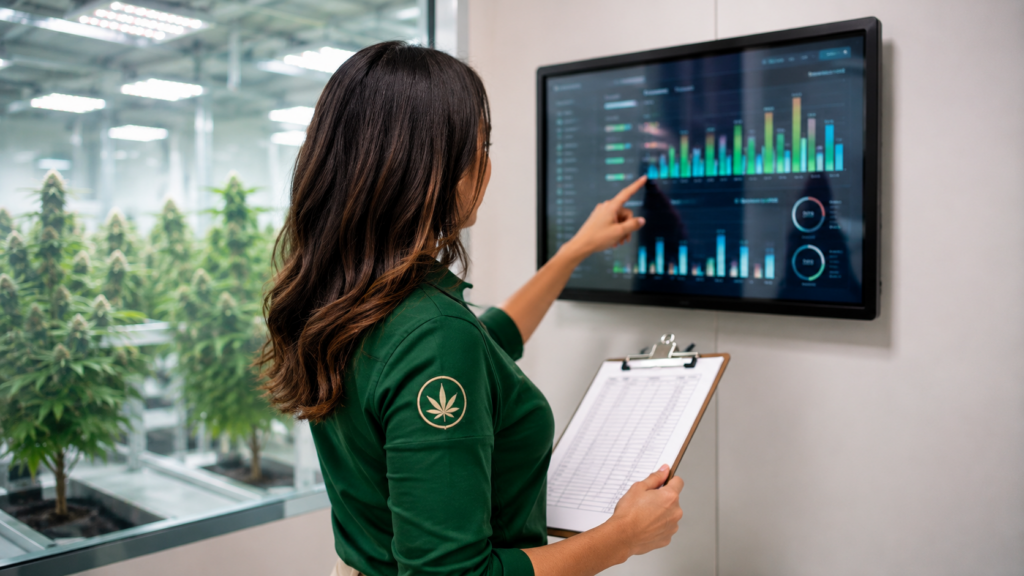
Understanding these responsibilities can provide useful context for how compliance functions within regulated cannabis operations. Specific duties vary depending on the organization, license type, jurisdiction, and individual position.
Skills That May Be Useful in Compliance Work
Education is one way to develop cannabis-specific knowledge, while employers may also consider previous education, work experience, transferable skills, and position-specific qualifications.
Depending on the position, useful knowledge may involve areas such as testing requirements, packaging and labeling, inventory controls, transportation, recordkeeping, or licensing. Structured education can provide opportunities to learn about regulatory frameworks and administrative concepts relevant to the cannabis industry.
Skills that may also be useful in compliance-related work include:
- Attention to detail.
- Organization and recordkeeping.
- Written and verbal communication.
- Research and information review.
- Problem-solving.
- Familiarity with policies and procedures.
These skills can apply across different administrative and regulatory responsibilities, although individual employers determine the qualifications required for specific positions.
Understanding the Broader Compliance Career Outlook
Cannabis-specific employment projections for compliance officers are not available from the U.S. Bureau of Labor Statistics. Looking at the broader occupation can, however, provide context for understanding compliance work across industries.
The U.S. Bureau of Labor Statistics projects employment of compliance officers across all industries to grow 4% from 2025 to 2035, about as fast as the average for all occupations. These figures are not specific to cannabis employment.
BLS also reports that compliance officers generally typically need a bachelor’s degree for entry-level positions, although requirements vary by employer and role. Cannabis-focused education should therefore be viewed as one potential component of preparation rather than a guarantee of eligibility for a particular position.
Building Cannabis-Specific Knowledge
Cannavision’s Cannabis Compliance and Administration Diploma provides online coursework focused on regulations, compliance, administration, and related cannabis-industry concepts.
Coursework can help students build familiarity with regulatory and administrative concepts used in regulated cannabis environments. The program provides an opportunity to develop cannabis-specific knowledge that may be relevant when exploring compliance-related opportunities.
Education alone does not guarantee employment or qualification for a particular compliance position. Career requirements can vary based on the employer, responsibilities, location, previous education, and professional experience.
Explore Cannabis Compliance Education
If you are interested in learning more about cannabis regulations and administrative practices, explore Cannavision Institute’s Cannabis Compliance and Administration Diploma.
You can also request information to learn more about the curriculum, admissions requirements, and online learning format.