


The regulated cannabis industry includes a range of business functions, from retail operations and compliance to transportation, logistics, and supply-chain coordination. Each area involves different responsibilities, workplace procedures, and qualifications.
For individuals interested in cannabis industry careers, understanding these different functions can help identify potential career directions and educational goals.
Cannavision Institute’s Cannabis Studies Associate of Applied Science (A.A.S.) offers qualifying students an opportunity to expand their knowledge of cannabis legislation, regulatory considerations, and the industry’s social and economic environment.
While the degree may complement previous education and professional experience, individual career opportunities depend on employer requirements, applicable regulations, and additional qualifications.
What Does a Cannabis Studies A.A.S. Cover?
Cannavision Institute’s Cannabis Studies A.A.S. is a degree-completion program designed for students with qualifying previous cannabis-related education.
The curriculum emphasizes cannabis legislation, state and federal regulatory considerations, social justice issues, and the broader economic and cultural context of the industry.
Students engage with academic material through research, written assignments, and presentations, developing additional knowledge of the factors influencing regulated cannabis businesses.
This education can provide context for exploring different areas of the industry. However, specialized occupations may require technical training, professional experience, or credentials beyond the A.A.S.
Five Cannabis Industry Career Areas to Explore
1. Cultivation and Production
Cannabis cultivation involves plant care, environmental monitoring, and production procedures within regulated facilities.
Depending on the employer, cultivation-related responsibilities may include monitoring growing conditions, assisting with plant maintenance, documenting activities, and supporting harvesting procedures.
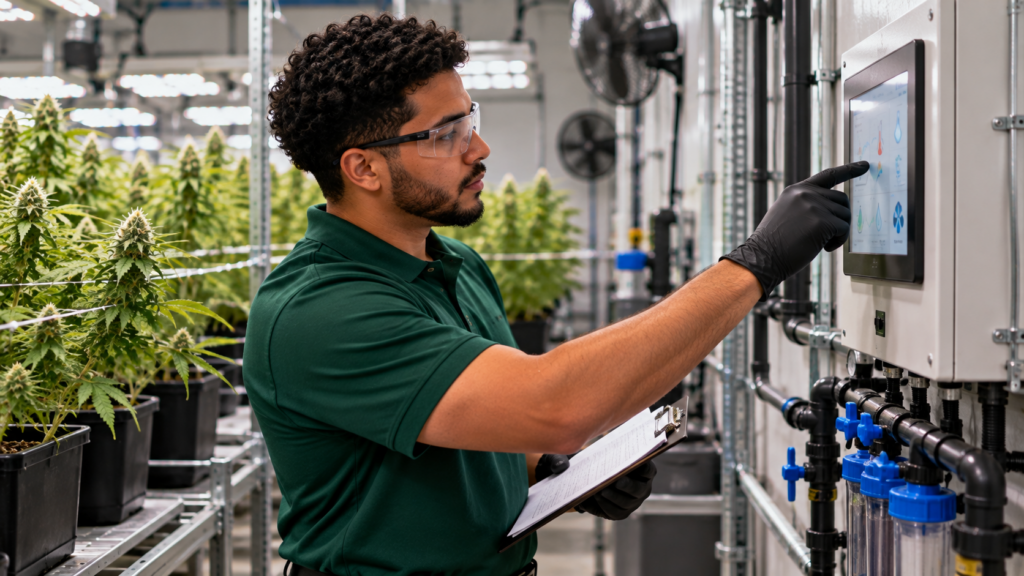
Potential areas to explore include cultivation technician and post-harvest support positions.
These roles may require horticultural knowledge, facility-specific training, and practical experience. Lead-grower and cultivation-management positions generally involve additional qualifications and responsibilities.
2. Processing and Manufacturing
Cannabis processing and manufacturing involve transforming plant material into products while following applicable safety, sanitation, and regulatory requirements.
Workplace responsibilities may include production support, packaging, documentation, and quality-control procedures.
Some positions involve specialized equipment or manufacturing processes. Extraction operations, for example, may require technical instruction, equipment-specific training, and safety qualifications beyond the Cannabis Studies A.A.S.
Product development, laboratory testing, and other specialized functions may also require additional scientific or technical education.
3. Dispensary and Retail Operations
Cannabis retail businesses depend on customer service, inventory procedures, accurate documentation, and compliance with applicable regulations.
Dispensary employees may assist customers, maintain records, support inventory activities, and process transactions according to workplace policies and state requirements.
Retail-related functions to explore include:
- Dispensary sales and customer-service support
- Inventory documentation and reconciliation
- Retail administrative support
- Product tracking and recordkeeping
Supervisory and store-management positions may require previous retail experience, leadership responsibilities, or additional qualifications.
4. Compliance and Regulatory Support
Cannabis businesses operate under regulatory requirements that can vary significantly by jurisdiction and license type.
Compliance-related work may involve maintaining documentation, researching applicable regulations, supporting internal procedures, and assisting with audit preparation.
Potential responsibilities include:
- Organizing compliance records
- Supporting regulatory reporting processes
- Reviewing internal documentation
- Assisting with policy and procedure updates
Cannavision’s Cannabis Studies A.A.S. emphasizes legislation and regulatory issues, providing academic context relevant to understanding these responsibilities.
However, specialized compliance positions may require additional training, experience, or knowledge of particular state regulatory systems.
5. Transportation, Logistics, and Business Operations
Transportation, logistics, and supply-chain coordination are additional functions within regulated cannabis businesses.
These activities may involve inventory movement, recordkeeping, scheduling, administrative coordination, and compliance with transportation or product-tracking requirements.
Business administration and industry research can also involve examining regulatory changes, economic conditions, and organizational procedures.
Cannabis Studies coursework addressing legislation, social issues, and economic considerations may provide useful context for understanding these business functions.
Individual positions may require additional qualifications, particularly when responsibilities involve regulated product handling or transportation.
How Education and Experience Work Together
A Cannabis Studies A.A.S. can contribute to a student’s understanding of the legal, social, and economic environment surrounding the cannabis industry.
Workplace experience provides different opportunities to learn organizational procedures, develop practical skills, and understand specific job responsibilities.
Both formal education and professional experience may contribute to longer-term career development.
An associate degree alone does not guarantee employment, advancement, or eligibility for specialized positions.
Cannabis-related employment may also be subject to minimum-age requirements, background checks, identification cards, licensing, or other jurisdiction-specific regulations.
Prospective employees should review the requirements for the positions and locations that interest them.
Continue Your Cannabis Education at Cannavision Institute
Cannavision Institute’s Cannabis Studies A.A.S. is a 100% online degree-completion pathway designed for students who have already completed qualifying cannabis-related education.
The program requires 53 transfer credits from a cannabis-related concentration and totals 102 quarter credit hours.
The degree-completion portion is designed for completion in seven months.
For students interested in exploring cannabis industry career paths, the program offers an opportunity to continue studying cannabis legislation, regulatory considerations, and related social and economic issues.
Explore Cannavision Institute’s Cannabis Studies A.A.S. to review the curriculum, transfer-credit requirements, and admissions information.
You can also request information from Cannavision Institute to learn whether the program aligns with your educational goals.